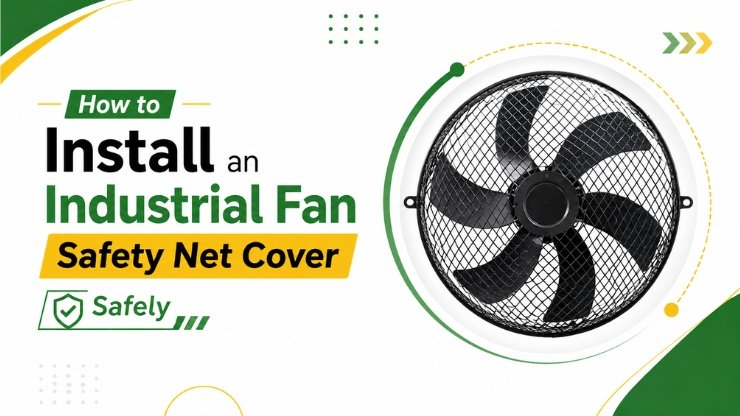
Industrial fans are widely used in factories, warehouses, workshops, manufacturing plants, and commercial spaces to improve air circulation. However, exposed rotating fan blades can create a serious safety risk, particularly when workers are close to the fan during normal operations or maintenance. Installing an appropriate industrial fan safety net cover can help reduce the risk of accidental contact with moving blades while maintaining proper airflow.
R&D Safety Solutions offers industrial fan safety net covers made from durable HDPE material, designed for industrial, commercial, and residential fan applications. The company’s product information highlights easy installation, durability, and protection against accidental contact with fan blades.
Here is a practical guide to installing a fan safety net cover safely.
1. Switch Off and Isolate the Fan
Before beginning installation, completely switch off the fan and disconnect it from its power source. Do not rely only on the wall switch or control panel. Where applicable, follow your workplace’s lockout/tagout or electrical isolation procedure to prevent accidental startup.
The fan should remain completely stationary before anyone works near the blades or guard. Industry safety guidance recommends disconnecting power before removing or working on fan guards.
2. Inspect the Fan and Existing Guard
Before fitting the safety net, inspect the fan frame, existing guard, mounting points, and surrounding structure. Look for loose bolts, damaged components, sharp edges, corrosion, or anything that could interfere with the installation.
If the existing fan guard is damaged or unstable, repair or replace it before installing the net cover. A safety net should complement a properly secured fan assembly rather than compensate for structural damage.
3. Select the Correct Safety Net Cover
Choose a safety net cover appropriate for the fan’s size, design, mounting arrangement, and operating environment. Measure the fan and identify suitable attachment points before installation.
According to the R&D Safety Solutions product page, its industrial fan safety net covers are intended for large industrial and commercial fans and are designed to provide protection while maintaining airflow.
For industrial applications, the guard design should also account for the fan’s mechanical hazards, operating conditions, and required safety distances. ISO 12499 specifically addresses mechanical guarding of industrial fans and provides guidance for designers, users, and installers.
4. Position the Net Correctly
Place the safety net evenly over the required fan opening. Make sure it does not touch the rotating blades and does not obstruct the fan’s normal airflow.
The net should sit securely without excessive slack that could allow it to move toward the blades during operation. It should also be positioned so that workers cannot easily reach through the protection and contact dangerous moving parts.
5. Secure All Attachment Points
Use suitable fastening methods for the fan and installation environment. Secure the net firmly at all required attachment points and check that the fixing system can withstand vibration during normal fan operation.
A properly installed guard should remain rigid and securely fixed during operation. Mechanical guarding standards emphasize secure construction and protection against hazards created by rotating fan components.
Avoid improvised ropes, weak ties, damaged fasteners, or temporary attachments that may loosen over time.
6. Check for Interference
Before switching the fan back on, manually inspect the installation. Confirm that:
- The net is securely fastened.
- No part of the net touches the fan blades.
- There are no loose ends or sharp projections.
- The fan can rotate freely.
- The cover does not interfere with airflow.
- All mounting points are properly secured.
If the fan is installed above an occupied area, additional precautions may be required to prevent objects from falling into the fan or from the installation area. AMCA safety guidance recommends suitable guarding and safe installation practices for such applications.
7. Test the Fan Carefully
After completing the installation, keep people away from the immediate area and start the fan according to the manufacturer’s operating procedure. Observe the safety net for unusual movement, vibration, noise, or contact with the fan.
If anything appears loose or unstable, switch the fan off immediately and correct the installation before normal use.
8. Perform Regular Inspections
Installation is only the first step in maintaining fan safety. Inspect the safety net cover regularly for wear, cuts, broken strands, loose fasteners, deformation, or other damage.
Industrial fan safety guidance emphasizes proper installation, maintenance, and safe working practices.
Conclusion
A properly installed industrial fan safety net cover provides an important layer of protection against accidental contact with rotating fan blades. Safe installation starts with complete power isolation, followed by correct sizing, secure fastening, clearance checks, testing, and regular inspection.
For factories, warehouses, workshops, and commercial facilities, choosing a durable safety net and installing it correctly can help create a safer working environment without unnecessarily affecting fan performance. R&D Safety Solutions provides HDPE fan safety net covers for industrial, commercial, and residential applications.