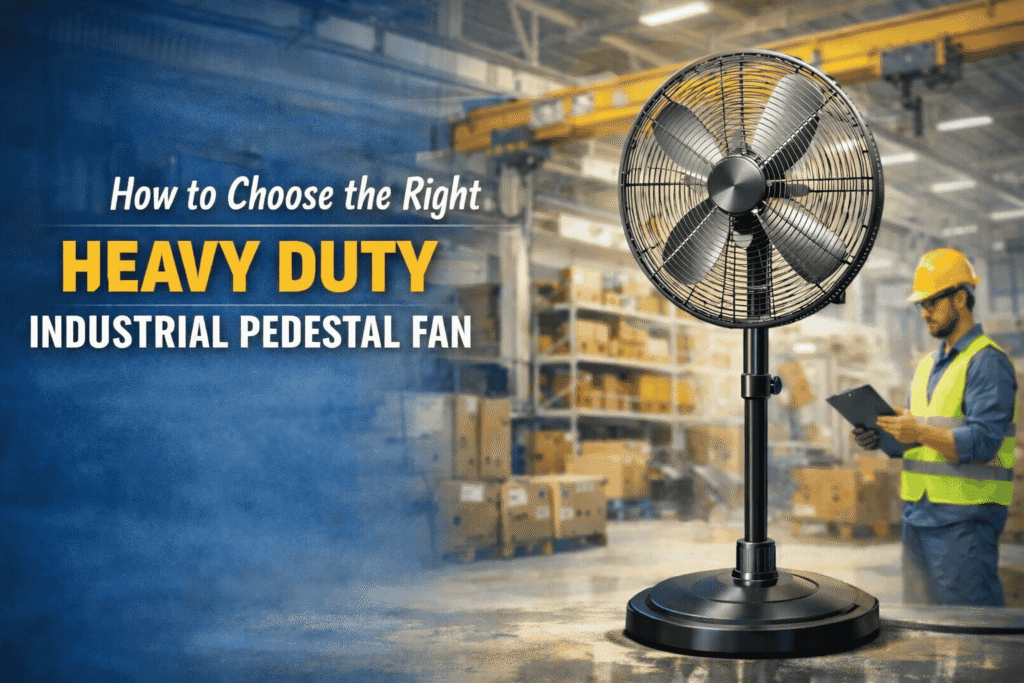
Take a walk through any busy warehouse, factory, or commercial kitchen during the height of summer, and you will quickly become aware of the thick, heavy heat that a regular household fan cannot begin to combat. While a regular pedestal fan may work well in a home bedroom, it is essentially useless in a 10,000 square foot production environment.
That is why industrial pedestal fans are designed for use in spaces and situations where a regular fan will burn out within weeks of operation. The trouble, of course, is that buying the wrong industrial fan, with the wrong size, airflow, and/or safety specifications, is a very expensive mistake many businesses make every year.
This guide will take you through all the things you need to know, but only the things you need to know, when it comes to selecting the right Heavy duty industrial pedestal fan for your needs. No technical jargon, just the essential info you need to make the right decision.
What Makes a Fan ‘Heavy Duty’ and Why Does It Matter?
So, it is a term that is thrown around rather loosely. Let’s define it precisely. A heavy duty industrial pedestal fan is not simply a bigger version of the fan you might have in the living room. It is a completely different class of product.
Here is what makes a genuine heavy duty industrial pedestal fan different from one that is simply designed to look the part:
Motor rating: Industrial fans use copper-wound motors rated for continuous duty meaning they can run 8, 12, or even 24 hours a day without overheating. Cheap fans use aluminium windings that degrade fast under sustained load.
Blade diameter: Most industrial pedestal fans have blades between 400mm and 750mm. Larger blades move more air at lower speeds, which reduces motor strain and noise.
Airflow (CFM or CMH): CFM stands for cubic feet per minute; CMH is cubic metres per hour. Industrial fans typically deliver 5,000 to 30,000+ CMH. A home fan might manage 1,500 CMH on a good day.
Build quality: Heavy gauge steel or reinforced ABS housing, powder-coated or galvanised finish, and robust adjustable stands rated for the fan’s weight.
Safety compliance: Properly rated industrial fans carry BIS, CE, or equivalent certification. The blade guard, also called a pedestal fan net cover or industrial fan safety net cover must meet specific mesh-spacing safety standards.
What Size Fan Do You Actually Need?
This is the question most people skip and it is the reason so many businesses end up with fans that are either too weak or overkill for the space. Getting the size right comes down to two things: the size of your space and the type of activity happening in it.
Step 1 Calculate your space in cubic metres
Multiply length × width × ceiling height. A 20m × 15m warehouse with a 6m ceiling gives you 1,800 cubic metres of space to ventilate.
Step 2 Decide how many air changes per hour you need
Air changes per hour (ACH) tells you how many times the air in a room should be fully circulated every hour. General guidelines:
Warehouses and storage: 6 to 10 ACH
Light manufacturing and assembly: 10 to 15 ACH
Heavy manufacturing, foundries, welding shops: 15 to 30 ACH
Commercial kitchens and food processing: 20 to 30 ACH
Gyms and sports halls: 8 to 12 ACH
Step 3 Work out the required airflow
Required CMH = Space volume × ACH. For our 1,800 cubic metre warehouse needing 10 ACH, that is 18,000 CMH total. If one heavy duty industrial pedestal fan delivers 9,000 CMH, you need at least two strategically placed.
Which Motor Type Should You Choose?
The motor is the heart of any heavy duty industrial pedestal fan. Getting this wrong means replacing the fan far sooner than you should. There are three main motor types you will encounter:
Induction Motors
This is the gold standard for true industrial use. Copper-wound induction motors are efficient, run cool, and last for years under continuous operation. They cost more upfront but have the lowest total cost of ownership. If your fan will run more than 6 hours a day, do not compromise on this.
Aluminium-Wound Motors
Common in mid-range fans marketed as industrial. They work fine for lighter commercial use 4 to 6 hours a day but they heat up faster and degrade sooner under heavy, sustained loads. Fine for a gym or retail space, not ideal for a production line.
BLDC (Brushless DC) Motors
More recent technology, considerably more energy-efficient with 50% less power consumption than induction motors at equivalent airflow. Quieter running and longer lifespan. The disadvantage is that it is more expensive and has fewer repair options in small towns. Something to consider if energy costs are a significant concern for your business.
| Motor Type | Best For | Daily Run Time | Running Cost |
| Copper Induction | Heavy industrial, 24/7 use | Up to 24 hrs | Moderate |
| Aluminium Wound | Commercial, light industrial | 4–6 hrs | Low upfront, higher long-term |
| BLDC | Energy-conscious facilities | Up to 24 hrs | Lowest running cost |
Does the Pedestal Fan Net Cover Actually Matter?
Yes and it is not just about safety compliance. A pedestal fan net cover directly affects who can safely work around the fan, how long the motor lasts, and whether your facility passes a safety inspection.
Here is what to look for in a proper industrial fan blade guard:
Mesh spacing: The openings in the guard should be no larger than 12mm in any direction. This prevents fingers and loose cloth, cables, or debris from reaching the blades. IS 302 and CE standards both specify this.
Material: Steel wire guards are stronger and more durable than plastic mesh. In industrial environments with flying debris, metal is the right call.
Full coverage: The guard should cover the full front and rear of the blade assembly, not just the front face. Rear-entry to blades is a common and underappreciated hazard.
Secure locking: Guards must clip or bolt firmly in place. A guard that can be easily removed or knocked off by passing workers or machinery is not doing its job.
An industrial fan safety net cover is not optional in commercial or industrial settings; it is a legal requirement under most workplace safety regulations in India and internationally. If a vendor is selling a heavy duty industrial pedestal fan without a proper blade guard, that is a red flag.
What About Industrial Fan Safety Net Covers for High-Risk Environments?
Standard pedestal fan net covers are okay for warehouses and workshops. However some places need a special industrial fan safety net cover made for places where things can go really wrong.
You need a strong safety net cover if your workplace has any of the following things:
Textile mills or garment factories: The fan can suck in loose threads and start a fire. You need a safety cover with small holes, less than 6mm to stop this from happening.
Chemical or pharmaceutical plants: If the fan blades hit something it can make sparks. That can be very bad. You need guards that do not make sparks and these guards are often made from special materials that do not catch fire easily.
Food processing facilities: The guards need to be made from a kind of steel that is safe for food and easy to take apart to clean. You cannot use the guards with paint on them here.
Outdoor or -outdoor industrial sites: The guards need to be protected from rust and water so they are often covered with a special coating or made from a material that does not rust.
Places with a lot of dust, like cement plants or flour mills: The fan needs to have a cover to stop dust from getting in and breaking the motor. The cover needs to be very tight and have small holes to keep the dust out.
If your environment falls into any of these categories, specify this clearly when talking to a supplier. A generic heavy duty industrial pedestal fan may not be enough; you need one spec’d for your actual conditions.
What Features Should You Check Before Buying?
Once you have the basics sorted size, motor, safety cover here are the specific features to tick off before you finalise a purchase:
- Height adjustment range: Most industrial pedestal fans adjust from around 1.2m to 1.8m. For high-ceiling warehouses, look for models that go up to 2.2m or can be fitted with extension columns.
- Oscillation: Automatic left-right oscillation covers a wider area. Check the oscillation angle 90 degrees is standard, 120 degrees is better for open floor plans.
- Speed settings: Three speeds is the minimum. Variable speed control (via dial or remote) gives you much finer control over airflow and noise levels.
- Tilt angle: The fan head should tilt up and down by at least 15 degrees in both directions. This lets you direct airflow where it is actually needed.
- Base stability: The base should be wide and heavy. A narrow or light base on a powerful industrial fan is a tipping hazard, especially on vibrating factory floors.
- IP rating (for outdoor or wet areas): If the fan will be used near water, steam, or outdoors, look for at least IP44 rating on the motor housing.
- Cable length: Industrial spaces often have power points far from where the fan needs to sit. A 3m to 5m cable is the bare minimum. Longer is better.
5 Mistakes People Make When Buying Heavy Duty Industrial Pedestal Fans
- When buying fans people often look at wattage. They should look at airflow instead. A higher wattage doesn’t always mean air movement. For example a designed 200W fan can move more air than a poorly designed 400W one. So always compare the CMH ratings, not the watts.
- Industrial fans can be really loud. If your workers need to talk to each other on the floor you should check the noise level in decibels. If it’s above 70 dB at 1 meter it’s uncomfortable for a time. Look for fans with blade designs that reduce noise.
- Don’t save money by not getting a safety cover. A fan without a cover is a risk. One injury claim will cost more than the difference in price between a cheap fan and a safe one.
- Some people buy one fan instead of two medium ones.. One big fan just creates one strong airflow path. Two fans placed well can create cross-circulation, which cools and ventilates a space evenly. For industrial spaces two fans are better than one.
- Before buying fans check if spare parts are available. Industrial fans can break down. Ask if motor spares, replacement blades and guard parts are available locally. If not it can be a maintenance problem. An imported fan, with no spare parts can cause trouble.
The Bottom Line
When you need a duty industrial pedestal fan do not just look for the biggest one or the one that costs the most money. You need to find a fan that’s right for the space you have, the work you do and the safety rules you must follow.
First think about the size of your space and how much air needs to be moved. Then pick a motor that can run all day without stopping. The heavy duty industrial pedestal fan net cover is also very important especially if you work in a place where there are a lot of hazards. A standard industrial fan safety net cover may not be good enough for you.
Before you buy a duty industrial pedestal fan get all the details about it and make sure you can get extra parts if you need them. Remember, using two duty industrial pedestal fans in the right spots is usually better, than using one big one. If you do these things you will have a setup that keeps your people cool, your machines working and your safety record good.